
Analytic reasoning can only ever say what the world is. Meaning comes from the intentional placing of what is into the narrative structure that our brain is capable of perceiving. Is changes nothing. Meaning transforms lives. God lives at the intersection of what is and what “is” means.
Author: jkwest44
Responding to the first two weeks
The challenge I have with making a coherent statement at the moment is that there are so many competing, subtle, and deeply problematic things going on that it’s impossible to treat any aspect well. I also recognize that humans (individuals and societies) are systems far more so than they are a discrete and single thing. Any one part of our experience and upbringing is always in conversation and/or competition with all other aspects of who we are. For me to attempt to say anything meaningful requires me to weave together a variety of strands within the system that get us to where we are now.
The greatest danger I find in Trump’s presidency (something I thought during the campaign rhetoric and something he has lived up to so far) is not in the concrete actions that he may or may not take, nor the wars that he may or may not start. I’m not at all convinced that Trump’s goal isn’t to burn it all to the ground and wind up with power and wealth galore. But, for now at least, those are distractions from what is already so dangerous and harmful about a figure like Trump.
The greatest danger I see is that most evil in the world does not come through overt, obvious, concrete actions. Most of the world’s evil comes in the form of subtle, passive aggressive, divisive, often implied actions and words that instill fear and do violence to relationship. Many of the worst offenders generally look and interact like a normal person. Whether or not Trump has meant or done anything overtly problematic, he has done everything with callous disregard for the people most affected and with such deep disdain for anyone who disagrees. That in itself is extremely harmful and will cause more harm than any good his orders and actions could conceivably do in the long run, if ever deemed reasonable and implemented appropriately.
Even if you don’t agree that his actions are security theater and will cause more harm than good, his words completely justify the fear and anxiety that he has caused. You cannot tease apart the specific, letter of the law actions Trump has so far made from the bombastic, hateful, xenophobic, and caustic campaign rhetoric that he used to rile up crowds during and since the election. If it is in any sense reasonable to say people have overreacted to the specific, narrowly interpreted actions Trump has taken so far, the blame for that overreaction lies squarely at the feet of the man who ran a campaign on promises to do exactly the things that protesters fear he is already doing.
Children who suffer physical abuse are often some of the most gifted at reading the emotions of others. The skill is often learned in an attempt to avoid the next round of abuse – if you can tell when the parent is angry or drunk, you know when to act normal and when to respond accordingly. For so many marginalized and trivialized groups of people, they have read the emotional state of the president and where things seem headed. It doesn’t matter at all whether things are going to be as bad as people expect – unrest and uncertainty are in many ways worse realities than overt acts of discrimination or abuse. This is the reality we are forcing a great number of people to live in – and it doesn’t make the slightest bit of difference whether or not that is the intent of Trump or a fair reading of the actual words in his executive orders.
How you do something is at least significant as what you do. If you’re on the playground, it makes you a bully; when you’re the president, it makes you the worst kind of abuser. If you’re famous, you might rally a crowd; when seeking office you have no idea and no control over the backlash your words will have on others. It makes no difference to me at this point how you describe the specific actions Trump has taken or whether you think they come from a good or reasonable place of protectionism and safety. The manner in which he has done everything is inherently problematic and hurtful in some of the worst ways.
At least 6 interrelated strands of thought are necessary to express why I say all this –
- An African Proverb – “If the young are not initiated into the village, they will burn it down just to feel its warmth.” (from a ted talk podcast on what we need to know about europe’s muslim children – the talk is about why young muslims are drawn to extremism when they are rejected by the dominant culture).
- My understanding of Sallie’s MFT training – when you repeatedly tell your child they are “X,” they will often spend their whole life trying to live up to or reject that label. Some are driven to be the smartest, for instance. Others are crushed by their inability to be smart enough. Still others intentionally fail so as to be seen as not smart as possible.
- A critique of modernity from Stanley Hauerwas – Modernism is the story that “you should have no story except the story that you chose when you had no story.” (explored here in relation to American religion; from my perspective as to why social identity is more basic than individuality here)
- Symptoms vs diseases – We are infinitely more likely to address the symptoms that we can see than the disease underneath. This happens especially in relationships. One of the greatest challenges to heal current wounds is that the internet and partisan politics are terribly suited to create the space in which people can express their brokenness and find healing.
- Tribalism – people want an identity and a community that safely defines the insider and the outsider. We will forgive a multitude of sins as long as we get to be on the inside. Multiple theories attempt to put a hard number on the limits to a human tribe and others show the problems with too much open access to resources. But for Christians to view our ‘tribe’ as anything short of all creation is precisely to reject the gospel. (#s 2 and 3 here, in the form of a sermon here)
- Predictors of Societal Violence – One of the stronger predictors of societal violence is unequal and especially limited access to vital resources. I can’t think of one specific source to cite, but it’s not hard to find historical examples – race riots in mid 20th century America, the connection between drought and the Arab Spring, the French Revolution, the disparity b/w the US and Mexico, the conflicts of the Protestant Reformation, etc. All share the fact that when at least one group doesn’t feel their needs met, violence is likely to rise up.
Trump’s campaign promises and his actions so far seek to 1) reject any attempts to change American culture and values, from inside or out – holding tight to some magical picture of ‘great’ is a flat out rejection of the young and the diverse; 2) label vast communities of people in dramatically simple, negative terms that only name problems and never speak of hope in anything but himself; 3) speak grand pronouncements about ‘greatness’ and other such lofty words without saying what he means or even critiquing those who interpret those words as a rejection of foreigners and the civil rights movements; 4) talk incessantly about ‘fixing’ problems without even a tacit acknowledgment of how we arrived where we are or what reconciliation and justice might entail apart from a police state; 5) isolate America from the rest of the world in every conceivable way; 6) prevent government attempts to redistribute wealth to meet the basic needs of all.
If you actually want to make the world a safe and better place, you would have to start by 1) finding ways to embrace and value the differences of the next generation and the neighbor who doesn’t look and think and act like me; 2) speak to the reality you hope to create in the world rather than constantly name the fear and brokenness you see; 3) recognize that we are all a part of an interconnected, global story that no one alive created nor does any one person or nation control; 4) actually create the spaces for conversation and healing rather than just stick a band aid (or pour gasoline) on centuries old divisions; 5) encourage the development of tribes that recognize rights are not pie, and lives are not actually a zero sum game, economically or theologically; 6) and invest in ways to ensure that the increasing automation of the workforce and changes in technology become means of human flourishing rather than a primer for the next great social (and military) revolution.
Nothing about what has happened gives me hope for positive change. Nothing makes me feel even the slightest bit safer or more empowered.
It was said countless times that Trump was all talk in order to rally the votes, but he should not be taken literally and he would back down and mellow when in office. It’s time to accept that we really can take Trump at his word; he says what he means and means what he says. Whether or not he starts WWIII, he is already doing a great amount of harm by traumatizing an unbelievable variety of people (victims of sexual violence, fully documented and employed immigrants, LGBTQ persons and supporters, foreign officials, refugees, men who are masculine enough to show emotion, Jews, African Americans, inner city residents, democracy itself, and I’m sure I’ve missed others).
It would be bad enough to have to create this list, but not once has Trump so much as acknowledged that anything he said could have been harmful, much less flat out wrong. The only ‘apology’ I’m aware of is the most clear cut example of a statement written by someone else that I have heard from him; but more than that, an actual apology is not an opportunity to tell the world why we’re wrong for being bothered by something you admit to having said. Nothing in him shows the capability for remorse, regret, or change. He has, at best, deflected the criticism and told the people he harmed that they’re wrong to feel hurt and has challenged the reality of the criticism for everything he’s done. At best, that makes him an ass. More likely, Trump is gaslighting us all.
I am proud of the UMC response and not surprised at all to see the vast array of other peaceful protests that have already happened. It is all entirely justified, regardless of where you stand on a narrow interpretation of what Trump has actually done and regardless of the danger in what might come next. Reasonable people can disagree on whether some of the principles behind Trump’s policies and actions are justifiable or beneficial in the long run. But the divisive and harmful rhetoric that Trump has spoken and that which he has allowed to go unchallenged is a direct affront to pretty much everything I believe is good and holy in life.
As a blonde haired, blue eyed, white, cis gendered, heterosexual, married, American, protestant, pastor I’m about the only kind of person with nothing to fear directly from Trump. I recognize that puts on me a distinct requirement to speak up and I will try to do so in whatever ways I am able.
The gospel I preach and to which have given my life says power is made perfect in weakness, not in the ubermensch. Our words will not change the world, but we are called to witness to the one who did. And there is room for all at the table of the Lord. I pray that all my words and actions reflect hope, trust, love, and fear in the Lord – no matter what that looks like.
Partisanship is Like a Broken Marriage
In plenty of relationships, one partner will make a logical, reasoned argument regarding one thing or another and the response would lead an outside observer to believe that the argument was actually an attempt to burn the house down with the partner in it. One could say “we need to spend less money” and the other could hear “you’re a waste of money.” One could say “you’re doing that wrong” and the other could hear “your existence is wrong.”
The problem? One partner names a behavior that needs to change. The other feels a brokenness that needs to heal. No matter how good or right the arguments may be for changing behavior, the brokenness isn’t going anywhere until the need for healing is addressed. The problem is not that either of the approaches or any of the arguments and feelings are right or wrong – the problem is that building up the relationship is impossible until both are speaking the same language and dealing with problems rather than symptoms. As long as people talk on different levels, nothing good happens and the cycle of hurt feelings and intractable arguments continues.
The present partisanship in the United Methodist Church (and America in general) is like a marriage stuck in the same cycle. Conservative voices say we reject homosexual acts. Liberals say you reject people. The arguments of both sides are equally heartfelt and sincere but will never match logic and emotion until both sides can figure out how to build a relationship rather than win an argument. If a solution is to be found, it will have to be far more imaginative and creative than drawing a line in the sand and crystallizing the fact that we will always talk past and never with each other. Relationship is nothing without the coherence of logic and emotion.
Logic gives words, without which experience can’t be understood or lead anywhere. Emotion gives power, without which words are useless and void.
I tell every couple that I marry that there is no right and wrong in a marriage – there are only things that build up relationship and things that tear it down. If either person loses, nobody wins. I’d offer that same advice to the global church now. Even when you are absolutely correct in where you stand, you haven’t necessarily even addressed the problem that divides you from your partners in the Body of Christ. You can keep yelling, but that won’t make anything better as long each side continues to debate symptoms and can’t find a way to dig down to relationship.
Methodists have long claimed to represent a religion of both head and heart. It’s about time to unite head and heart in each person, movement, and side rather than just having a host of people and groups choosing one over the other and living under the same umbrella.
Scripture and dishwashers
I know a few couples who fight about the right and wrong way(s) to load a dishwasher. What goes on the top rack? How much pre-cleaning is necessary? How closely can you stack dishes? I wouldn’t dare to offer a resolution to the fight here. But I will say that when a disagreement over loading the dishwasher turns into a knock down drag out yelling match, the dishwasher is only a symptom of something much larger beneath the surface.
The fight over the dishwasher represents the relationship dynamics that give life and meaning to the marriage. Sometimes that life and meaning is beautiful and can hold people together through anything – sometimes it is dysfunctional and can allow something as insignificant as cleaning habits to cause great harm. The fight is important because it is a fight, it is clear evidence that something is wrong. But this kind of intractable fight can only be overcome when relationship dynamics are healed. And if the relationship dynamics are healed, the couple is likely to find a workaround – like having only one person ever deal with the dishwasher – rather than look for a fight.
To argue over whether scripture means what it says is like asking if a fight over the dishwasher is really about the dishwasher. Yes, it does mean what it says, just like the fight is about the dishwasher. But meaning always goes deeper than a surface reading and if we never get beneath the surface, we’ll always fight over symptoms and never find relationship, with God or one another. There is no way to capture relationship inside of words but there is also no way to be in relationship without words.
To assume the question of truth or falsity is as simple as “did God mean it” or “is it true” (no matter whether the answer is yes or no) is to do violence to the way life and relationship work. Seeking truth in the words of Scripture is like digging beneath the symptomatic fights of a marriage and feeling the reality of the experience underneath. Finding truth by the power of the Holy Spirit is like mending the wounds that have festered for far too long. Only in lived relationship, community, and tradition can we even know what our question of scripture actually means. Only through the healing power of God can we begin to live into the fullness of the truth we seek in the words we say.
Community underneath individuality
Understanding intelligible action is one of Alasdair MacIntyre’s areas of focus in After Virtue. He argues, for instance, that the intent to be gardening comes before the actions necessary to garden. You might fail to do anything intelligibly gardening related, but you can’t act without the intent of doing some particular intelligible action. This means that the narrative in which you are participating (or at least trying to participate) is more fundamental than the possibility of discrete or unconnected action. There may be a multitude of simultaneous narratives at play and you may appear to others to be doing something other than what you’re trying to do, but that does not mean that discrete action is at the ground level – some particular narrative is underneath all action.
I suspect there is an analogy to be made between discrete action vs intelligible action and the individual vs community. Postmodernity and much of modern ethics suggests that we are individual agents first and that we then have to make decisions of how to act – the results, responsibilities, and/or intentions of which will define whether we are seen as ‘ethical’ or not. The problem is that the individual is no more a meaningful concept than discrete action. To name any characteristic or meaning of an individual is to presuppose a community/narrative definition in which that individual either fits or does not fit. Denying community is ultimately denying the possibility of a coherent life. And an incoherent life has no purpose, no aim, no direction, no character.
The implication is that I can never define myself apart from the narrative language and categories of thought from communities into which I do and do not fit. From the moment we are born, who we are is defined more by the people in our lives than by whatever it is that makes us a distinct individual. Even in rejecting the influence of those in our lives, we can only do so because of the way in which their influence upon us has provided the space to develop categories of acceptance and rejection of the way they are. To claim that I am X, whether in agreement or distinction with those who have influenced my individuality, requires a conception of what “X” and therefore “not X” entails such that acceptance and rejection are possible choices to be made.
The ‘self made man’ is a recent falsity that obfuscates the extent to which an individual cannot have meaning or character apart from community. Thus, the modern notion of self denies our inherent need for a definable community to embrace or reject. The compartmentalization of life institutionalizes the fiction that there is a definable or meaningful self that exists apart from the life they live. To recognize that the self is first defined by community is to at least reject the notion that what is true for person A could possibly be true irrespective of the people in A’s life. Relativism can only be true to the extent that it is a rejection of the defined alternatives in one’s life – but there is no definition of alternatives or rejection that is not itself the acceptance or rejection of a communally defined position.
The fiction of an autonomous self is often viewed as the moral agent who must make choices about how to live. But if the narrative/communally defined self is more basic than the autonomous self, what most determines the “goodness” or “badness” of actions and character and identity is grounded in the most basic and fundamental narrative into which the agent is attempting to live. There is no objective and autonomous agent who can be defined as “good” or “bad” as such. To be a perfectly ethical person is to fully embody the virtues and never the vices of a given narrative – but there is no objective ground on which an observer might stand to determine whether or not that is the case and there is no way to separate overlapping narrative contexts of a life in such a way as to prevent an action that is virtuous in one context from having some characteristic of a vice in any of the overlapping contexts in which each person necessarily lives. Imperfect moral action is, therefore, not a possibility but the rule.
tl;dr
- Community is more basic than individuality to the same extent that intelligible action is more basic than action as such. Individuality per se is just as meaningless as action per se.
- Who we are is determined more by how we are formed than by how we affect the world, even if who we are is exactly equivalent to whatever it is that defines the difference between one person’s effects and another’s.
- Defining an ethical person is only possible to the extent to which we can define a coherent narrative context in which to locate that person’s thoughts, intents, and effects.
- Any narrative definition of a life will be marked by multiple incomplete and competing narratives, which means both that any narrative context can never be fully defined and that the moral implications of a person’s actions will never be limited to a single narrative context.
18
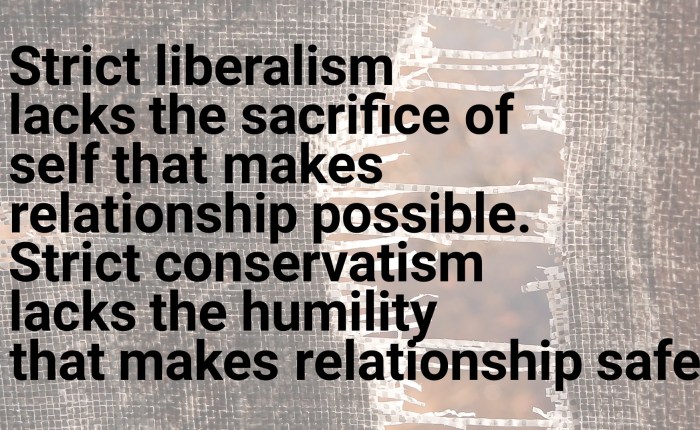
Strict liberalism lacks the sacrifice of self that makes relationship possible. Strict conservatism lacks the humility that makes relationship safe.
Love vs Hate
Love and hate are two of the most powerful forces in our lives. Love and hate are two sides of the passion by which all the world is transformed and yet love and hate could not be more different.
Hate separates. Love transforms.
Hate is destructive. Love is creative.
Hate is powered by fear. Love is powered by trust.
Hate leads to separation from. Love leads to life together with.
Hate accepts any justification. Love rejects any excuses.
Hate seeks victory. Love seeks relationship.
Hate tears down. Love builds up.
Hate belittles. Love encourages.
Hate is restrictive. Love is imaginative.
Disruption as Applied to the Church
Disruption is a theory proposed by Clayton Christensen to describe a phenomenon of innovation in the business world wherein incumbents are successfully challenged by upstarts. This excerpt is from an article that thoroughly addresses the basics of the theory-
“Disruption” describes a process whereby a smaller company with fewer resources is able to successfully challenge established incumbent businesses. Specifically, as incumbents focus on improving their products and services for their most demanding (and usually most profitable) customers, they exceed the needs of some segments and ignore the needs of others. Entrants that prove disruptive begin by successfully targeting those overlooked segments, gaining a foothold by delivering more-suitable functionality—frequently at a lower price. Incumbents, chasing higher profitability in more-demanding segments, tend not to respond vigorously. Entrants then move upmarket, delivering the performance that incumbents’ mainstream customers require, while preserving the advantages that drove their early success. When mainstream customers start adopting the entrants’ offerings in volume, disruption has occurred.
(It is, perhaps, ironic that the linked article is an argument claiming that the theory’s success has led the to the term disruption being used far too broadly and casually. Here, I’m using it as an analogy for the church, which has nothing to do with the strict sense of the theory developed by Christensen.)
I find disruption to be a fascinating way to think about the reality of life in the institutional church (the incumbent) as opposed to life in various new churches (the upstarts). By “new churches” I mean to refer to one of any number of church starts (some within denominations, others intentionally started with no ties at all to any denominational body) in which the most defining characteristics of church life are rethought from the ground up. Styles of worship, the meaning of membership, alternate revenue streams, the role of pastors, the structures of leadership, and on and on are all developed based on what is best for the future of the church and not the way it’s always been done.
The upstart mentality allows the new church to narrowly focus on a particular way of doing ministry that forms a coherent mission and ministry practice. Doing a few things well is increasingly more important than doing many things in part. While incumbents fight over the most challenging segments of the market (like affecting broad cultural influence on the nation’s policies and politics through endless debates about the most divisive topics), newer churches simply target overlooked segments (like making sure someone is actually welcomed in the parking lot and made to feel like they are wanted in church life). The success of those single things done well provides the leverage to move upmarket into multi-campus churches, mergers, and deep partnerships, through which more and more of the market is saturated by the influence of the upstart more so than the incumbent.
In a sense, the disruption of the mainline church is inevitable. Many of the incentives and structures that made the institutional church what it is no longer exist or make sense. As explored in podcast form here, an organization’s greatest strength is often its greatest weakness. What made the church ideal as a country defining institution are often the very same qualities that prevent the church from moving forward into the new realities made possible by 21st century life. It may yet be possible to breath new life into the mainline church if we are willing to admit the significant shift in mentality required to respond to new realities of life. To do so would require that we at least consider Replacing Membership and Embracing Purpose.
Embracing Purpose
Perhaps the deepest problem the church currently faces is that the church was recently the most important organization in a person’s life, almost by default. For much of American history, it was the institution from which a person most consciously and thoroughly derived their identity. The business model of ‘church’ grew accordingly – the church did a little bit of everything so that it could reach everyone a little bit and provide a little bit for everyone to do. The difficulty of connecting with people across distance led to the inherent regional monopolies of one or a few churches over the inhabitants of a particular place. The lack of technology made it not only possible but virtually required to have a majority of people find their identity within some form of church community.
With the advent of the internet and societal shifts, people no longer require any particular organization from which to derive their primary sense of identity. A new community or distraction is just a click away. The core ministries of the church seem to be shifting to try and compete directly with every feed and activity that take up the time and attention of its members in the hopes of winning back enough attention to sustain the church’s presence in the world. The church, thus, becomes one of the many points of data on the stream of never-ending information and entertainment that vies for people’s attention online and in person.
But the local congregation will never win in this kind of quest for the same reason walmart will never ruin the business of high end, niche product manufacturers – mass production and low prices only get you so far. The geographic limitations of driving to a store are increasingly less important than what you can have shipped on the internet. And competing based on price means there is no loyalty to leverage into a defense against any future competitors. Walmart might remain a sustainable business in the field of cheap consumer goods. But if the church is asking people to give a deep part of themselves to the organization, it better have something more compelling to offer than location and cheap prices.
If the church is going to survive it must reevaluate the ways in which it provides an alternative narrative to the scattered, global, and stream focused attention of modern life. Instead of doing everything a little bit, each congregation must work to define its particular piece of God’s mission to transform the world and invite people to take part in that particular part of the mission. Embracing a definable and specific purpose for why each congregation exists may increasingly become the necessary precondition for anyone to consider participation in the life of a congregation.
What embracing purpose looks like is not at all clear and settled in my head, but it will likely involve at least the following: 1) a push toward specialization; 2) a steadfastness to its core mission matched only by its willingness to change the particular form of fulfilling that mission over time; 3) the freedom for participants to come and go for a season; 4) a meaningful process or pathway that participants can travel as they become more committed; 5) the desire to meet at least one (and maybe only one) concrete, felt need in the surrounding community; and 6) an explicit connection to the traditions and stories in which every Christian takes part.
 Thoughts